

“There is nothing so useless as doing efficiently that which should not be done at all.” — Peter Drucker
The most common question I get from founders right now arrives in almost the same words every time: “Should I hire a GTM engineer or a RevOps person?”
It’s a good question. It’s also the wrong one to answer first.
Because underneath it is a quiet assumption — that these two things are the same kind of thing, sitting on the same shelf, and you just pick one. They aren’t. And once you see why, the hiring decision, the org chart behind it, and even who ends up getting promoted all start to line up.
Let’s pull the thread.
GTM is just a title. RevOps a strategy, department, and title.
Go-to-Market (GTM) Engineering is a job title with a specific set of tasks: data enrichment, workflow automation, wiring tools together with AI on top. It’s technical, it’s real, and it’s genuinely useful.
It’s also young. Clay coined the term in 2023 — reportedly in an internal Slack thread about how to describe the AI-meets-automation work their team was doing — then built an ecosystem around it. It’s worth remembering the label was built, in part, to sell something.
Revenue Operations (RevOps) is a different animal. It’s three things at once: a strategic framework, a department, and a job role. The framework aligns the business across strategy, process, data, and technology. The department supports every commercial team you have. The GTM engineer? Usually one seat inside that function.
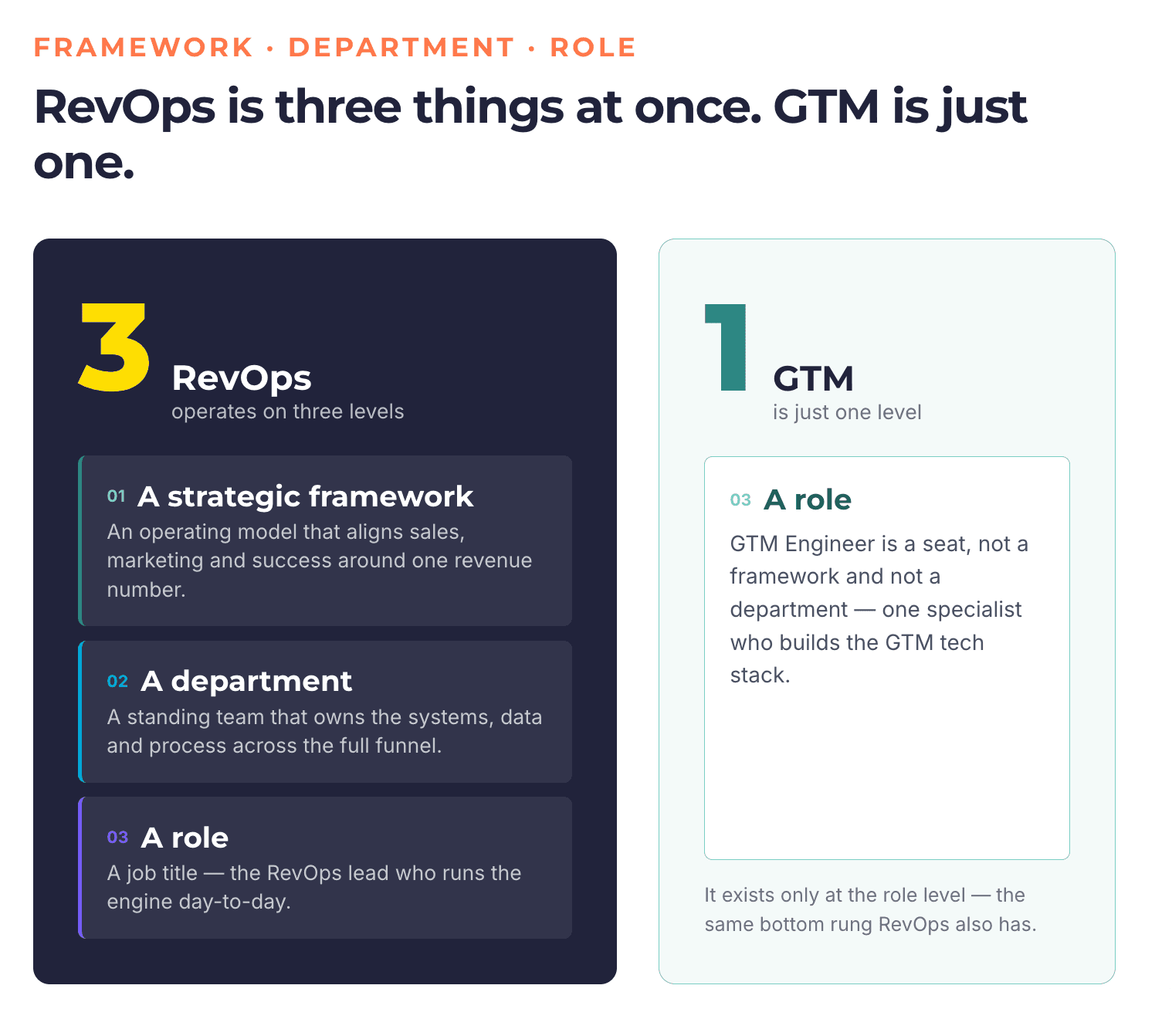
So the honest version of the question isn’t “which one.” It’s “which one first.”
My answer, most of the time: RevOps.
A GTM engineer is heavy on the technical side. Hand that person a business with no clear process and no strategic owner, and you get beautifully automated workflows that solve the wrong problem. Efficient execution of work that shouldn’t be done at all — which is exactly what Drucker was warning about.
A system nobody uses is just expensive furniture.
So your first hire is usually a generalist who leans strategic — someone who understands the business, the process, and the people before they touch a single automation. Then you complement them with the technical layer: a CRM admin, a GTM engineer, the wiring.
Build the thinking first. Add the wiring after.
(I unpacked the full comparison — where the GTM engineer title fits, and who to hire before whom — here.)
The problem with hiring one thinker
Say you take that advice. You hire the strategic generalist. Good call — for about eighteen months.
Then you grow. The commercial team goes from a handful of people to thirty-odd across sales, marketing, and customer success. And that one brilliant RevOps hire is now expected to set strategy, clean the data, own the Customer Relationship Management (CRM) system, design the automation, build the dashboards, run enablement, and figure out the AI roadmap.
On a good week, they do two of those well. The rest slip.
This is the moment the question changes again. It stops being “do we even need RevOps?” and becomes “how do we structure it?”
And 2026 makes that harder, for a reason most people miss. In our survey of 123 RevOps practitioners, roughly three-quarters reported an AI mandate from leadership. Only about a third had the data infrastructure to actually support it.
Distribute the weight, then find the pivot
RevOps rests on four pillars: Data & Insights, Processes, Systems, and Enablement. A good org chart is nothing more than those four pillars with owners’ names on them. Get them right and the boxes draw themselves. Pile all four onto one person, and you get the RevOps hire who’s quietly drowning.
Here’s how I distribute the weight:
Head of RevOps owns process and enablement — the human layer. Strategy, stakeholders, the people work that doesn’t automate. (And no, enablement is not a standalone hire. A pure enablement person with no RevOps skills produces decks nobody uses. Every time.)
Head of Systems owns tooling, automation, and AI — including, yes, a real software engineer. In 2026 you’re going to build, not just buy. Vibe-coding gets you a weekend prototype; it does not get you something your revenue team can run the business on.
Head of Data owns the engine. Inside RevOps, not borrowed from a central data team when it’s convenient. The third of companies winning with AI are the third that own their data.
Three heads pulling in three directions isn’t a system, though. It’s three departments that happen to share a name. So you add the pivot: a VP of Revenue Operations who orchestrates the whole thing — data feeds systems, systems serve process, process is what enablement teaches, and all of it points at revenue.
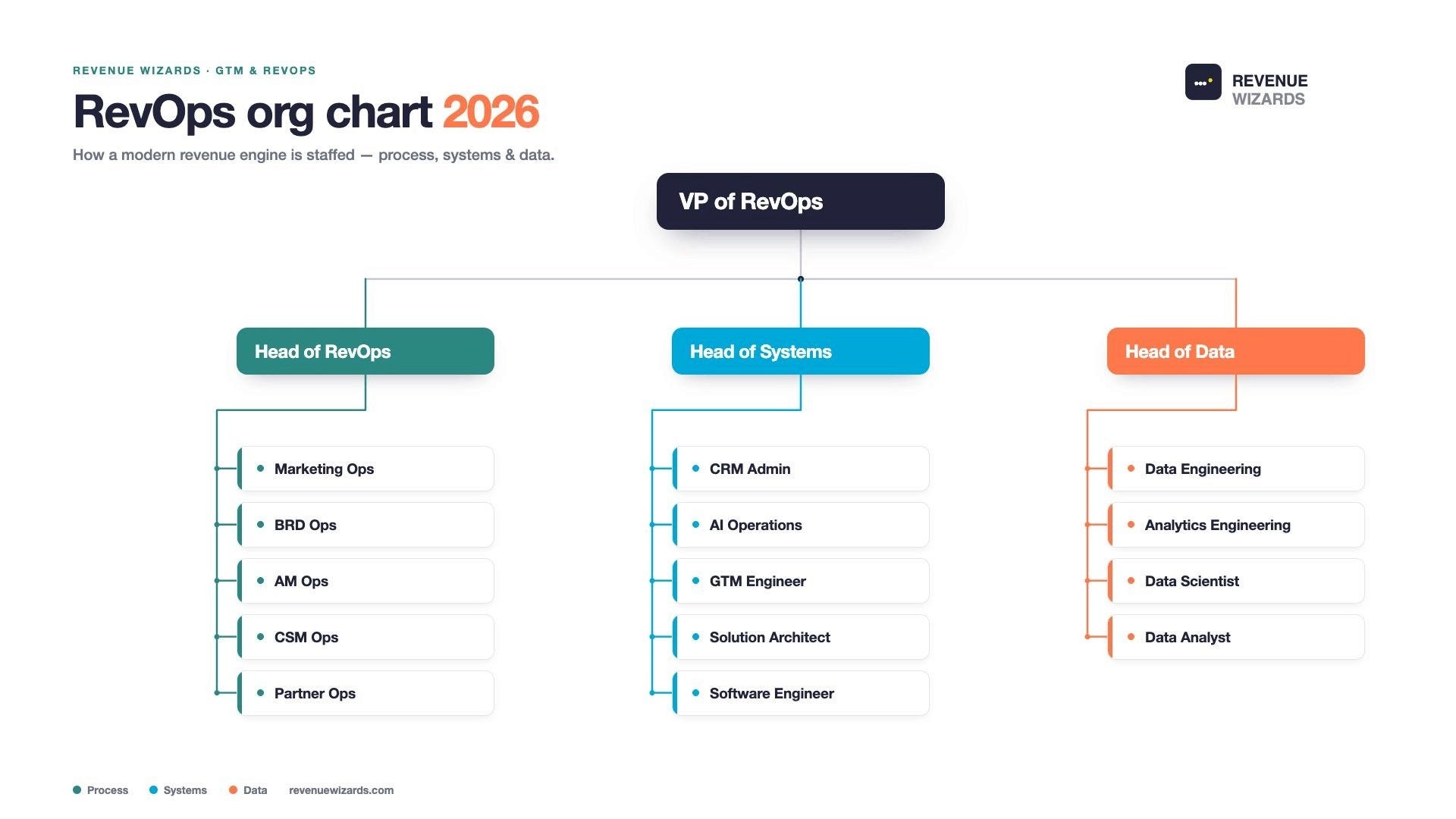
That’s the pivot point the entire structure swings around. Without it, you have weight with nowhere to transfer. With it, the same force moves something far larger than itself.
I’d run this for companies with 20 to 50 full-time equivalents (FTE) in commercial functions. Below that, it’s too heavy. (Full breakdown, with the chart, here.)
Which brings us back to who gets promoted
Notice what’s load-bearing in all of this. Not the automation. The thinking.
I’ve made this point before, and I’ll make it again: building AI workflows is becoming a commodity skill. The strategic layer — aligning your CRO, CMO, VP of Customer Success, and product team through the messy human work of meetings and decks and follow-ups — is not going anywhere. The people who get promoted are the ones doing crisp thinking and clean delivery. Not the ones who built the coolest flow.
That’s also why I keep half an eye on where the market is actually putting its money — because job titles tell you what companies think they need.
Hottest RevOps jobs this week
The running roundup continues, pulled from RevOpsRoles.com (built by Justin). Last time I ran this I featured roles at OpenAI, Adobe, Rippling, the London Stock Exchange, Mixpanel, and Zalando — the full set is in that edition.
This week’s picks, roughly mapped to the pillars above:
VP, Revenue Operations — 8x8 — US, remote, reports to CRO. The pivot seat itself.
Strategy & Operations Associate — LinkedIn — New York, hybrid, $89k–$145k, reports to CRO. The thinker side.
Manager, Revenue Enablement — Checkout.com — New York, hybrid. Enablement — ideally attached to someone who’s carried a domain.
Revenue Operations Analyst — Marigold — US, remote, $70k–$80k. The generalist entry point.
Top of Funnel Tooling Product Owner (f/m/d) - London, Amsterdam, or Berlin, hybrid. great team
Till next week!