

Most RevOps hiring problems aren’t hiring problems. They’re sequencing problems.
I talk to companies every week who built the wrong team at the wrong time. They hired CRM admins when they needed strategy. They brought in a VP before they had anyone to execute. They doubled headcount, then cut it in half six months later. Expensive lessons, every one of them.
Getting the structure right from the start saves you from all of it. Here’s how to think about it.
Three Profiles. Every RevOps Team Needs All of Them Eventually.
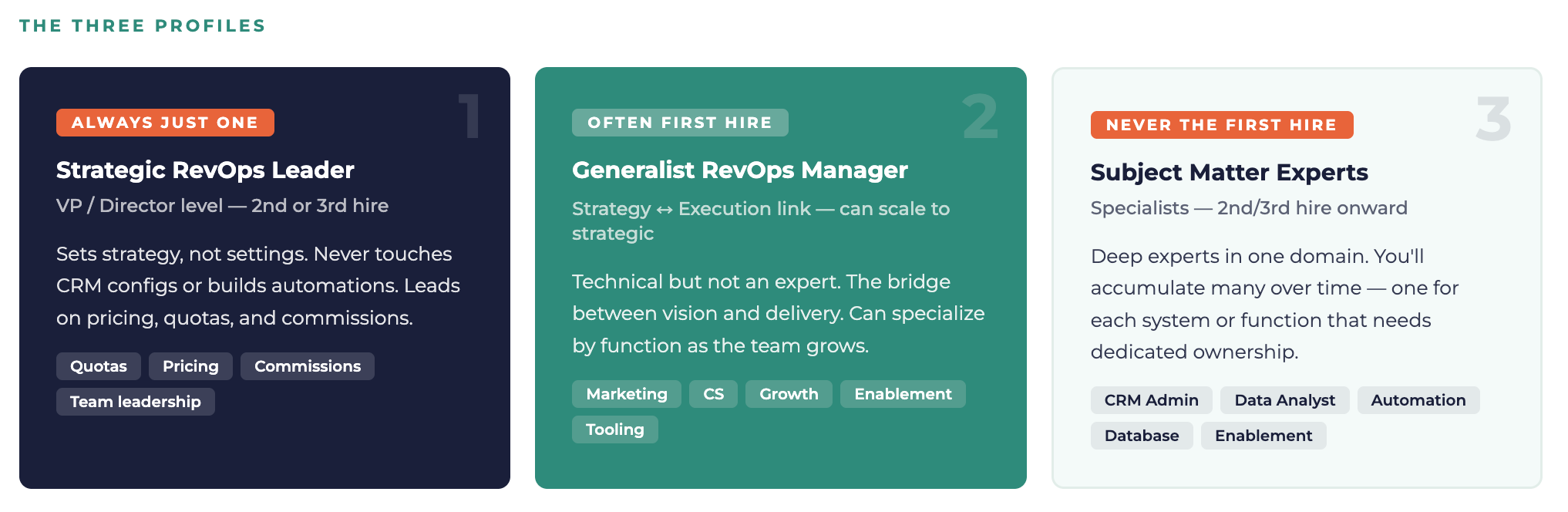
1. The Strategic RevOps Leader (VP or Director)
You need exactly one. The only exception is if you’re running two entirely separate business units — think AWS versus Amazon retail. Otherwise, one is enough.
This person sets quotas, designs commission structures, owns pricing decisions, and leads the team. They will never open your CRM to change a field setting. They will never build an automation. If they are, something has gone wrong.
They are typically your second or third RevOps hire, not your first.
2. The Generalist RevOps Manager
This is usually your first hire. As you scale, you’ll have several. They are the connective tissue between strategy and execution — technical enough to get things done, strategic enough to understand why.
As the team grows, generalists develop focus areas: marketing ops, CS ops, enablement, tooling, growth. They can eventually step into the strategic leader role. The best ones usually do.
3. Subject Matter Experts
CRM admins, data analysts, automation specialists, database engineers, enablement managers. These are not your first hire. Ever.
Bringing in an expert before you have a generalist to direct them is like hiring a Formula 1 mechanic before you have a driver. Impressive on paper, useless in practice.
Team Size by Structure
The sequencing question I hear most often is: who do I hire next? Here’s a clean framework.
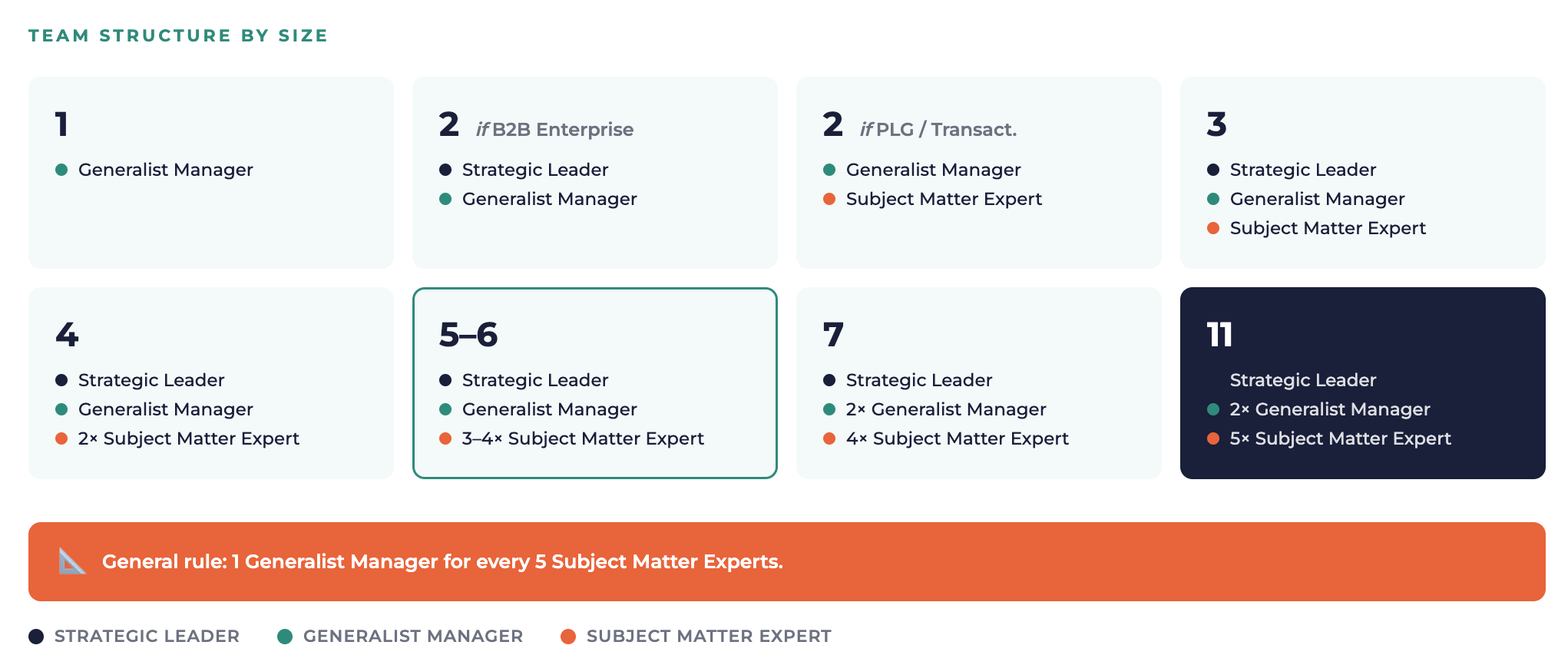
Team of 1: One generalist RevOps manager. They handle strategy and execution until you have enough to justify splitting those responsibilities.
Team of 2 — Enterprise/B2B focus: Add the strategic leader early. Enterprise deals require pricing discipline, quota design, and cross-functional alignment. You need someone senior managing those levers.
Team of 2 — PLG or transactional: Skip the VP for now. Add a subject matter expert instead. High-volume, low-touch models need technical horsepower more than strategic overhead at this stage.
Team of 3: Strategic leader, one generalist, one expert. This is the first complete unit. Strategy, coordination, and execution each have a home.
Teams of 4 to 6: Keep one strategic leader and one generalist. Stack subject matter experts underneath. This is where specialization starts to pay off.
Team of 7: Add a second generalist. At this size, one person can’t coordinate across all the workstreams. The ratio starts to hold: roughly one generalist for every four or five experts.
Team of 11: Still one strategic leader, two generalists, five or more experts. The ratio firms up. This is a mature, functional RevOps org.
The Ratio That Keeps Teams Functional
One generalist for every five experts. That’s the rule of thumb.
Break it and you get one of two failure modes. Too many experts without generalist coordination and things get built that nobody uses — technically impressive, strategically irrelevant. Too many generalists without experts and the team talks a lot and ships nothing.
Both are expensive. Both are common.
Where Companies Go Wrong
The most common mistake is hiring a strategic leader too early. A VP of RevOps with no one to lead is just an expensive generalist with a title problem. They’ll either get frustrated and leave, or they’ll start doing execution work they’re overqualified for and underperform on the strategy you actually hired them to drive.
The second most common mistake is hiring subject matter experts as the first or second hire. An expert without strategic direction defaults to what they know. Your CRM admin will build CRM things. Your data analyst will run reports. Useful work, but not necessarily the right work.
The third mistake is hiring for company stage you’re at, not the stage you’re heading toward. The generalist who got you from $2M to $10M ARR may not be the right fit from $10M to $50M. Plan for that transition before it becomes a crisis.
What to Do Next
Before your next RevOps hire, answer two questions: What does this person own, and who directs their work?
If you can’t answer both clearly, you’re not ready to hire. Get clear on that first. The cost of a bad RevOps hire — salary, opportunity cost, and the rebuild — almost always exceeds the cost of slowing down and getting it right.
Need help deciding who to hire? Talk to us.
Very insightful post.