

Most B2B referral programs die quietly. You launch with enthusiasm, customers ignore the “Make a referral” link, and six months later someone asks if it’s still running.
Only 30% of B2B companies have a formal referral program. But here’s the thing: those who get it right are operating at a 3:1 LTV:CAC ratio while the rest of us burn money on paid ads.
The problem isn’t that referrals don’t work. It’s that marketing owns them when RevOps should.
This Is a RevOps Problem
Referral programs get dumped on marketing because they look like a campaign. They’re not. They’re infrastructure.
Marketing can promote a program. But the operational backbone:attribution, CRM integration, reward fulfillment, cross-functional handoffs —> is RevOps territory.
Here’s what breaks when marketing runs it alone:
Attribution dies in your CRM. Someone refers a lead, your sales cycle runs 6 months, and you can’t prove the referral happened because cookie tracking expired.
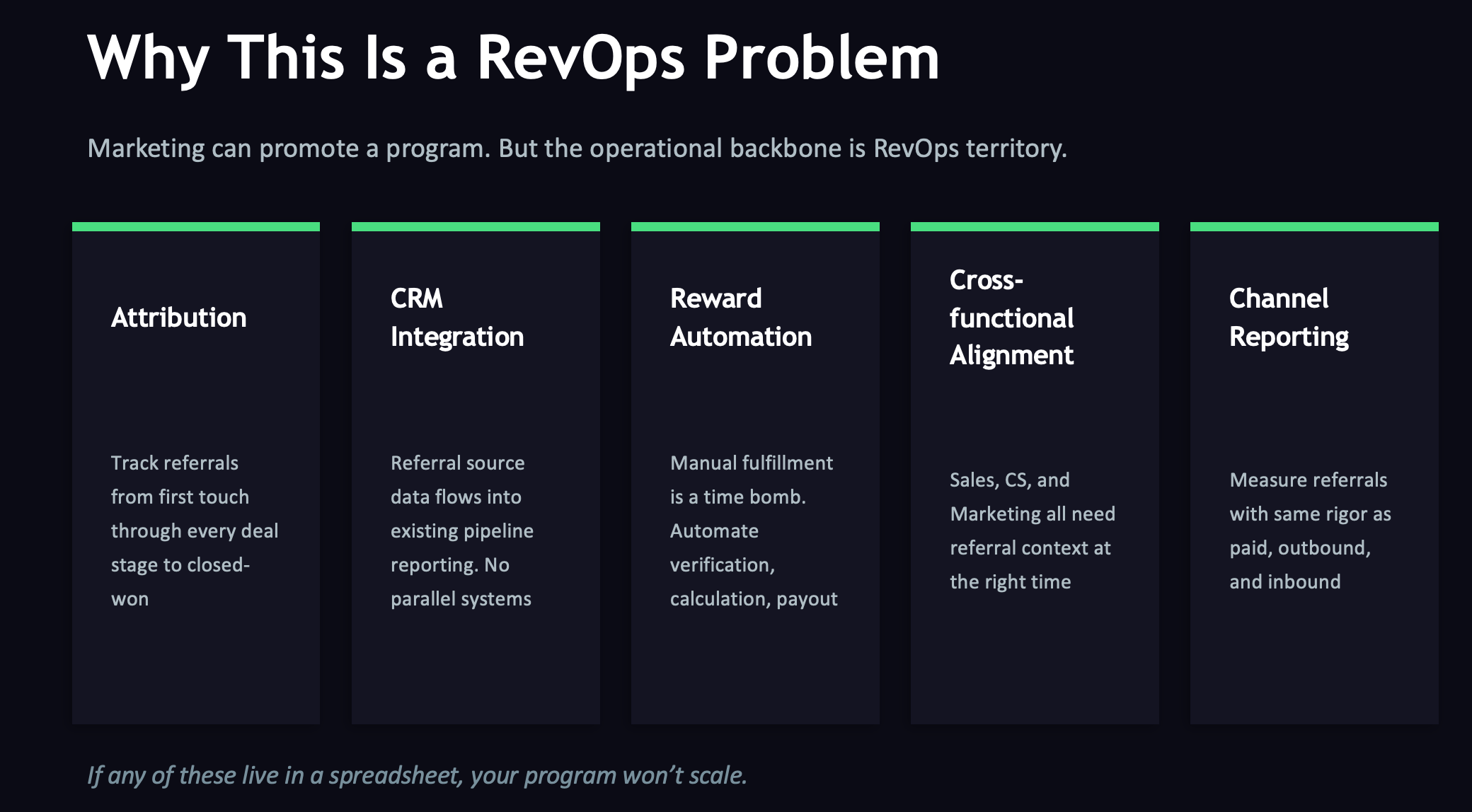
Rewards get paid manually. One person handles verification in a spreadsheet. They go on vacation and the whole thing stops.
Sales doesn’t know it’s a referral. The context gets lost between systems, so reps treat warm intros like cold leads.
Nobody measures it properly. Referrals don’t show up in your channel reporting, so you can’t compare performance or optimize.
If any of this lives in a spreadsheet, your program won’t scale.
When You Actually Need This
Not every company needs a referral program right now. Launching one at the wrong time burns goodwill with your best customers and delivers nothing.
You’re ready when:
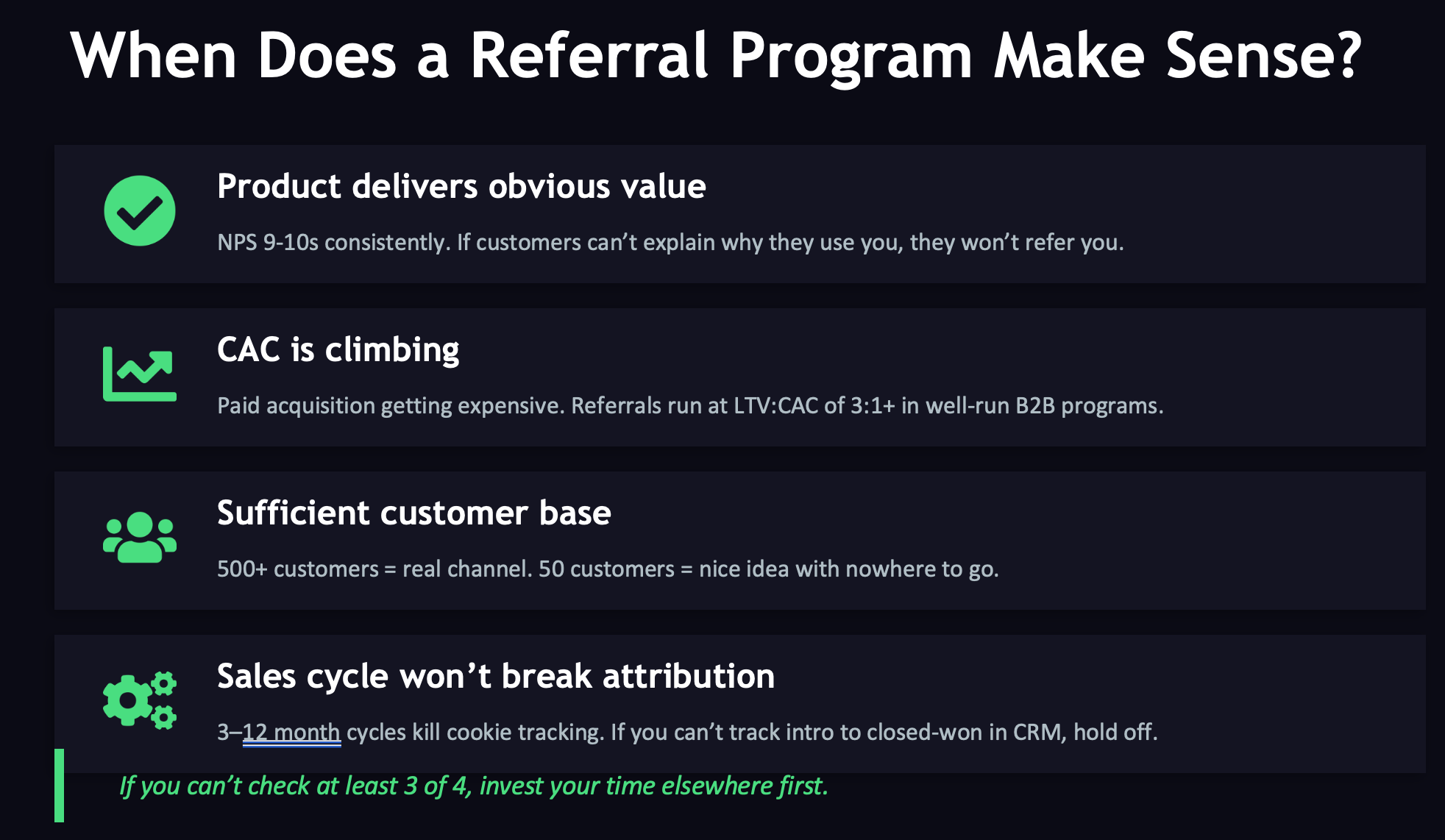
Your NPS is consistently 9–10. If customers struggle to explain why they use you, they won’t refer you. Fix the product experience first.
Your CAC is climbing. When paid acquisition costs keep creeping up, referrals become your most efficient growth lever.
You have 500+ customers. A referral program with 50 customers is a thought experiment. With 500, it’s a real channel.
Your attribution works. If your sales cycle runs 3–12 months and you can’t track a referral from intro to closed-won in your CRM, you’re not ready.
That last one is the killer for most B2B programs.
Build the Plumbing First
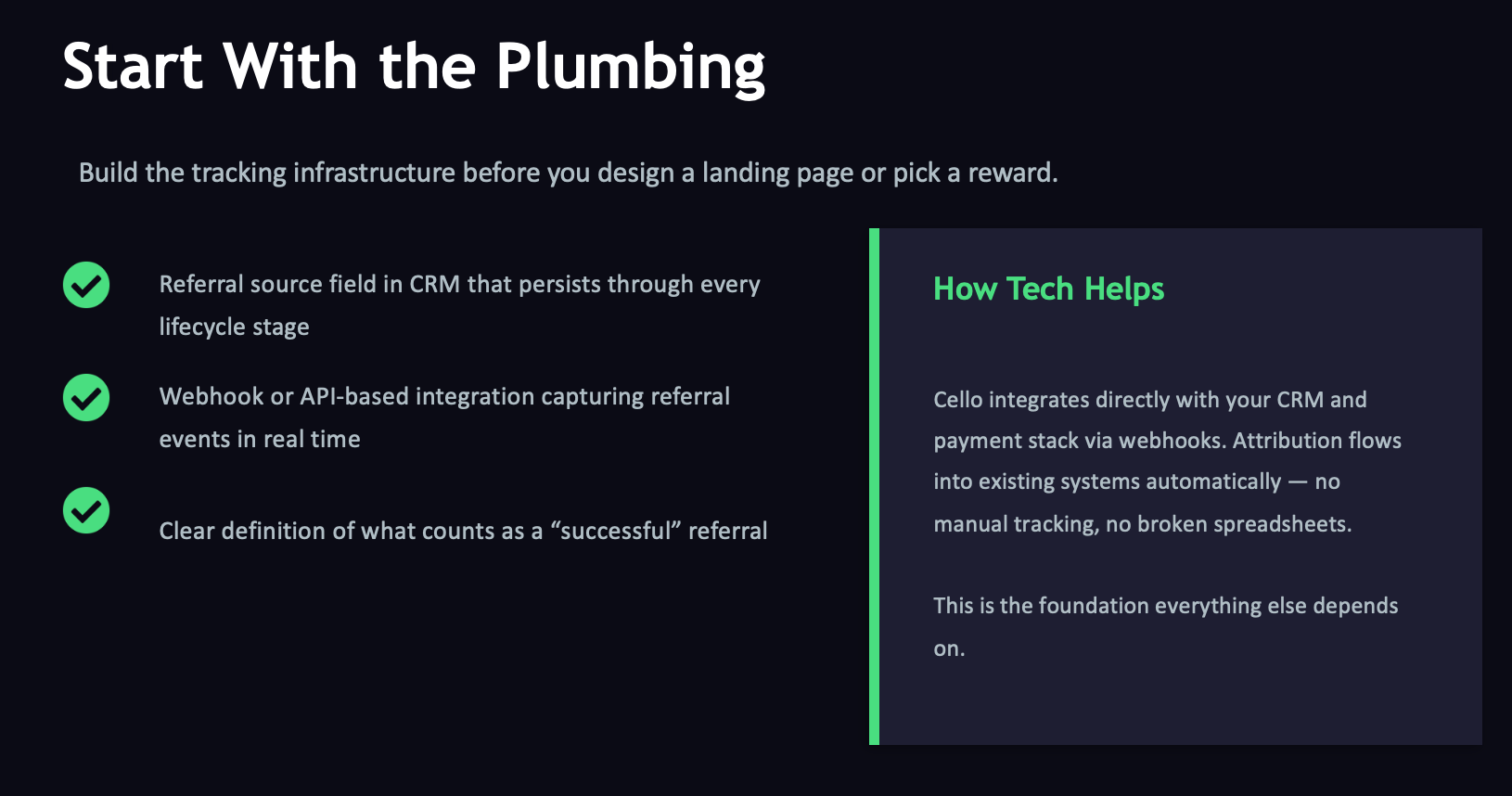
Before you design a landing page or pick a reward amount, build the tracking infrastructure.
You need a referral source field in your CRM that persists through every lifecycle stage. Not a tag that gets overwritten. A dedicated field that follows the deal from first touch to closed-won.
You need real-time integration. Webhooks or APIs that capture referral events as they happen, not batch uploads at month-end.
You need a clear definition of success. Demo booked? Contract signed? Subscription activated? Pick one and stick to it.
Most teams skip this step and regret it later.
Trigger at the Right Moments
Don’t slap a referral link in your footer and hope. Identify the specific moments when a customer is most likely to say yes:
Right after onboarding completion —> they just saw initial value
After they give you a 9 or 10 on NPS —> they literally told you they’d recommend you
At renewal or expansion —> they just doubled down on your product
When usage spikes —> power users are natural advocates
After a successful support interaction —> you just solved their problem well
The best programs embed the referral experience directly in the product, not on some external page nobody visits. A subtle prompt at the right moment beats a marketing email every time.
Design Incentives That Match Your Deal Size
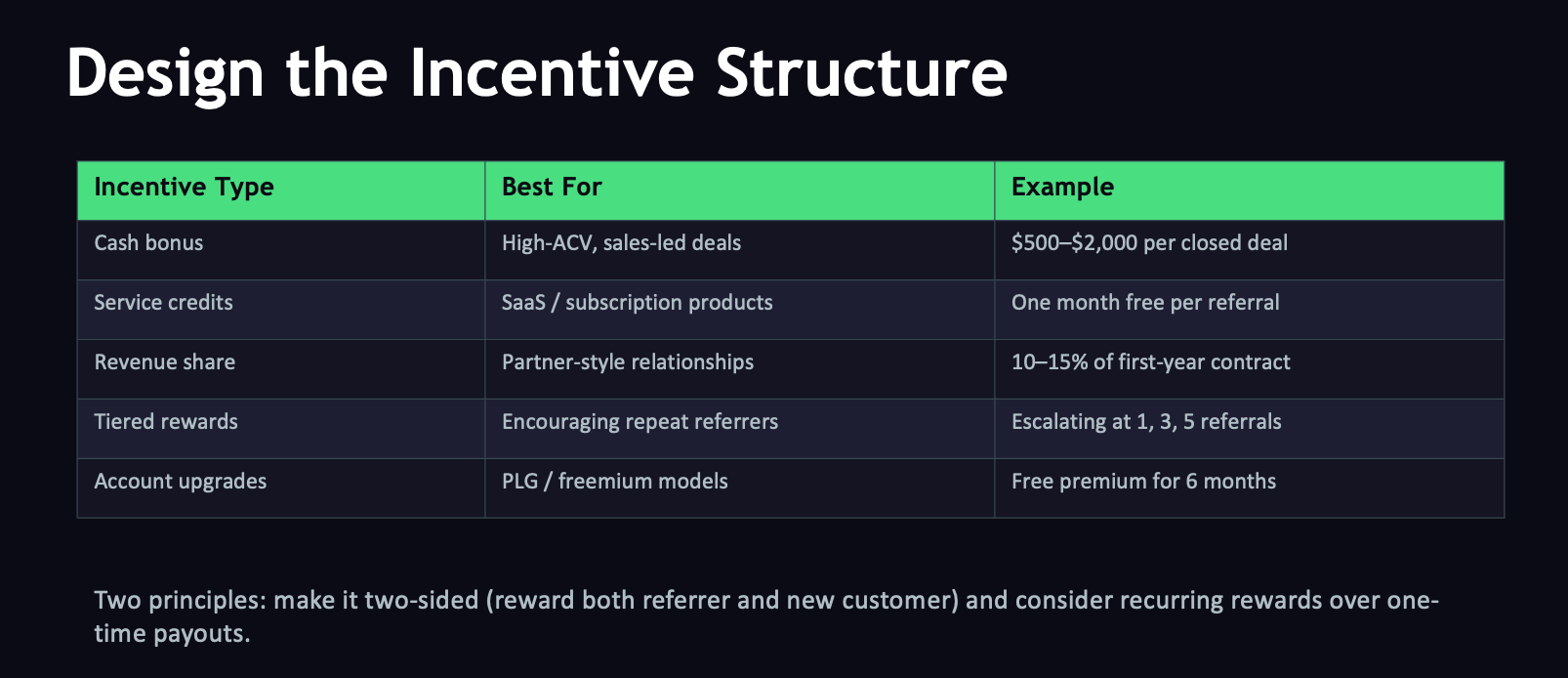
A $25 gift card for a $50K deal is insulting. Your rewards need to match your economics.
Common B2B structures:
Percentage of ACV: 5–10% of first-year contract value
Flat cash rewards: $500–5,000 depending on deal size
Account credits: Discounts on their own subscription
Recurring rewards: Ongoing payments for retained customers
Two principles matter: make it two-sided (reward both the referrer and the new customer), and consider recurring payouts over one-time bonuses to encourage ongoing advocacy.
Not All Referrers Are Equal
A customer who sends one lukewarm lead is not the same as someone who’s referred three enterprise deals.
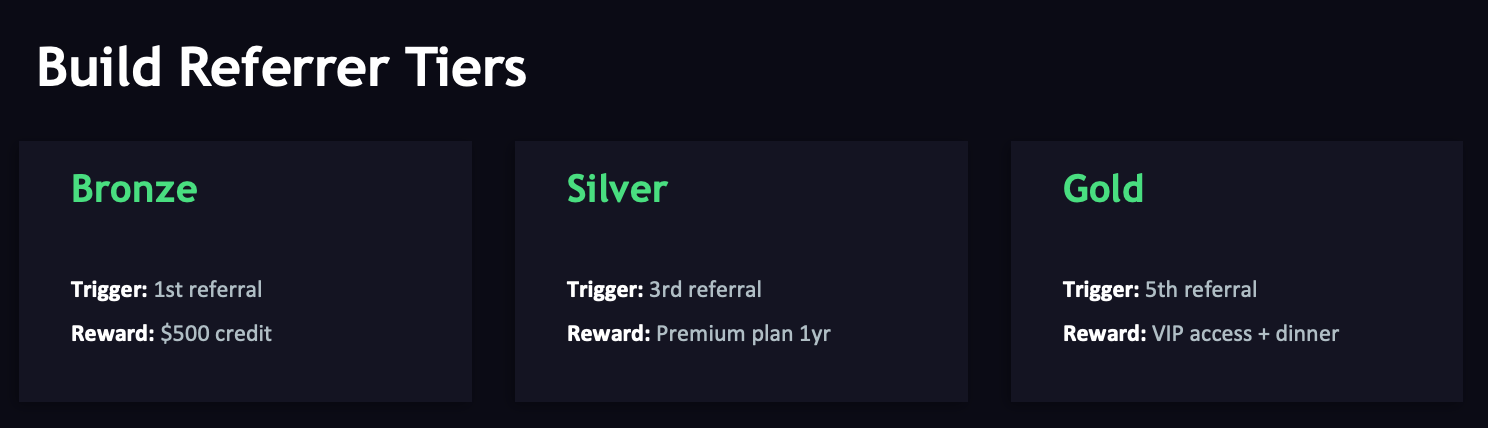
Build tiers:
Bronze: First successful referral → standard reward
Silver: 3+ successful referrals → 1.5× standard reward + quarterly check-in
Gold: 5+ successful referrals → 2× standard reward + direct line to leadership
Tiered structures turn a transactional program into a relationship. Your best advocates feel recognized and motivated to keep going.
Run It Like a Real Channel
This is where most programs die. They launch with enthusiasm and then nobody looks at them again.
What operational rigor actually looks like:
Weekly review. Some teams run a “Power Hour” where senior leaders review network overlaps and identify warm intro opportunities.
Monthly reporting. Track referral pipeline the same way you track every other channel—volume, velocity, conversion, revenue.
Quarterly optimization. A/B test your incentives, review participation rates, adjust triggers based on what’s working.
If you’re not treating referrals as seriously as paid or outbound, you’re wasting everyone’s time.
Measure What Matters
Track referrals as a standalone channel. Here are the metrics that matter:
Participation rate: Percentage of customers who make at least one referral
Referral-to-qualified lead rate: How many referrals turn into real pipeline
Referral-to-customer conversion rate: Compared to other channels
Cost per acquisition via referral: Including reward costs
Program ROI: Revenue generated vs. total program costs
Time to conversion: Sales cycle length for referred deals
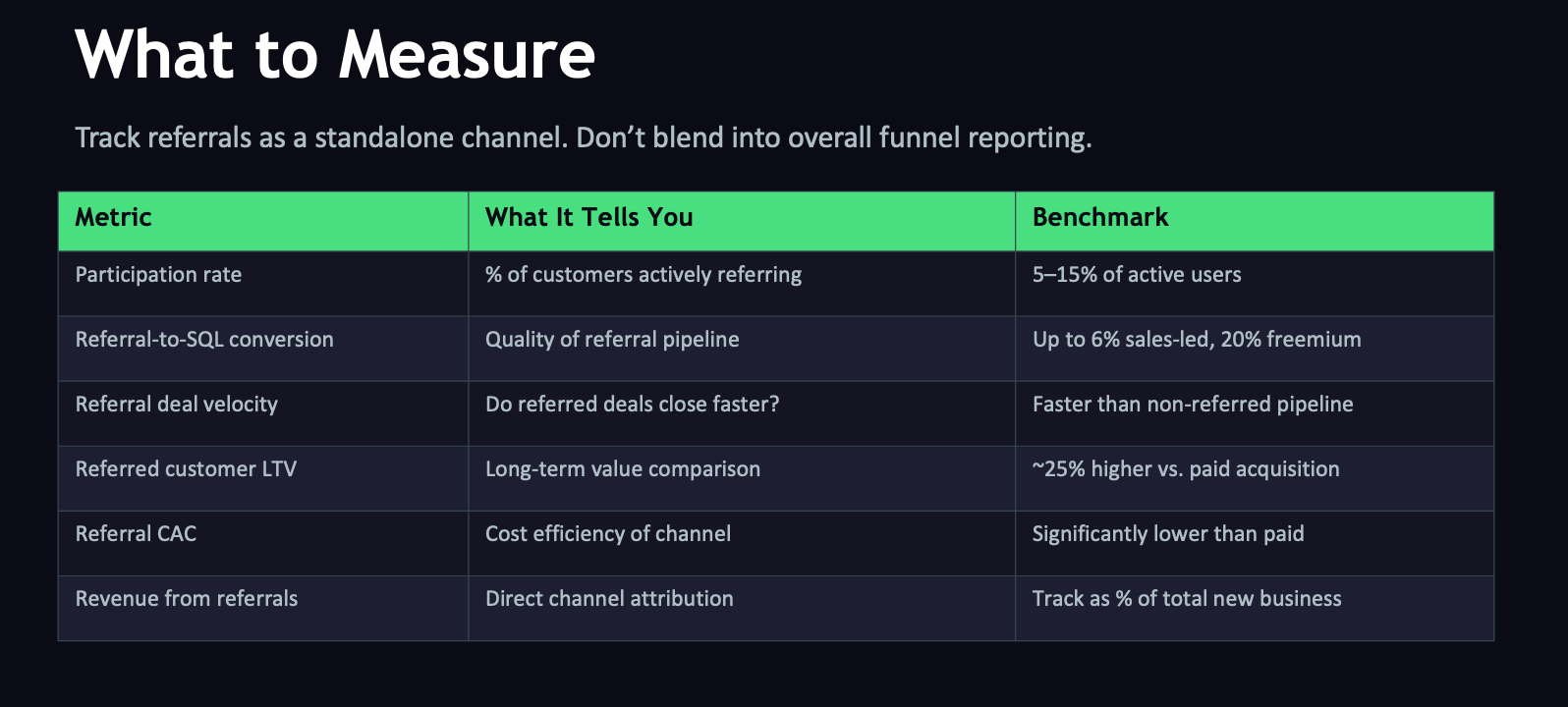
If referral conversion rates are lower than inbound, something’s broken in your sales process. If CAC via referrals is higher than paid, your rewards are too generous.
Need help with your Referral Strategy?
Reach out to us and ask about our GTM Strategy Services https://revenuewizards.com/services

User Referrals vs Partner Referrals
Most companies eventually need two referral motions:
User referrals: Your customers referring peers from inside the product
Partner/affiliate referrals: External partners, consultants, or influencers driving leads through their own channels
Running these as separate programs with separate tools creates fragmentation. Different tracking systems, different reward logic, different reporting. RevOps exists to eliminate this mess.
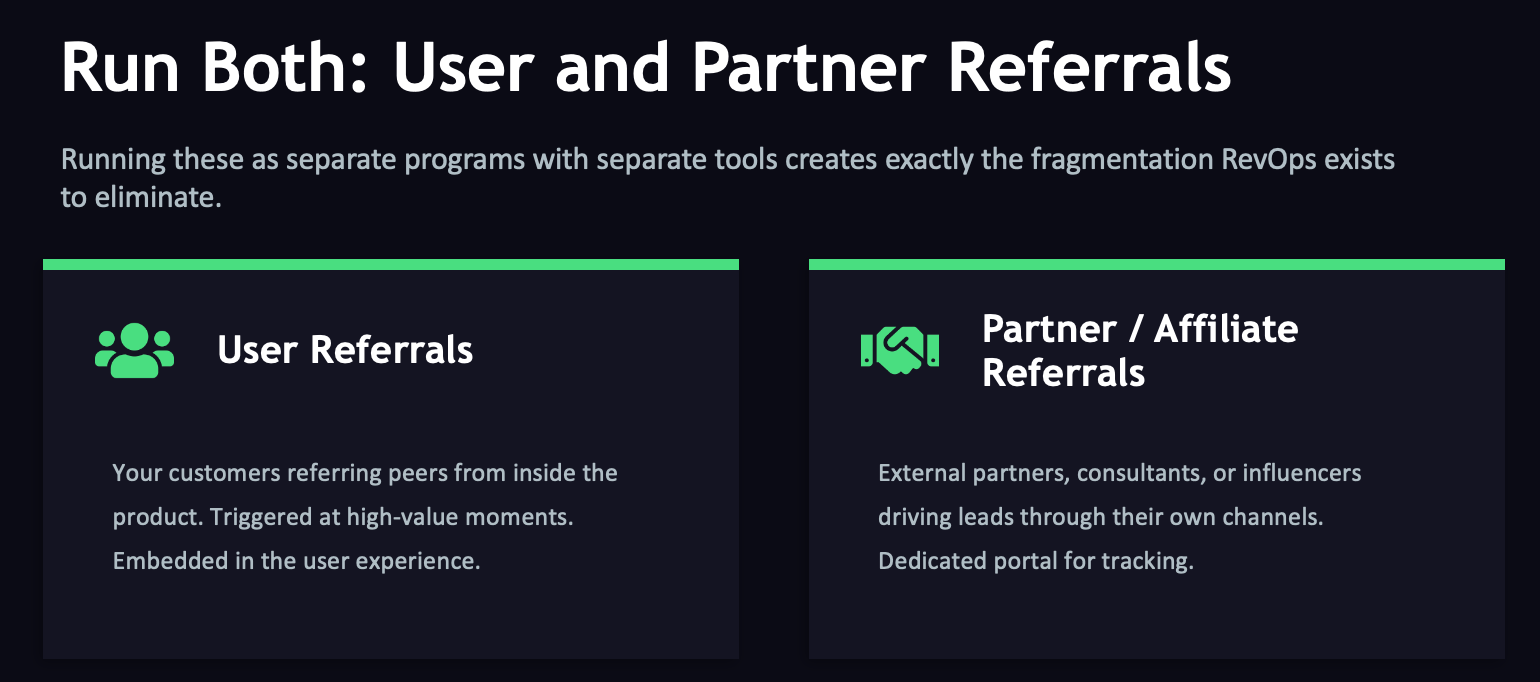
Find a platform that handles both in one place. Unified reporting, one integration to maintain, consistent reward management across both motions.
Build vs Buy
Quick decision framework:
Build in-house if:
You have dedicated engineering resources for ongoing maintenance
Your requirements are highly specific or regulated
You’re handling 10,000+ referrals per month with complex reward logic
Use a platform if:
You want to launch in weeks, not months
You don’t want to maintain integrations, compliance, or reward fulfillment logic
You need standard features like CRM sync, automated payouts, and analytics out of the box
The ROI math is simple: if the platform costs less than the engineering time and ops headcount you’d need to build and maintain the same functionality, use the platform.
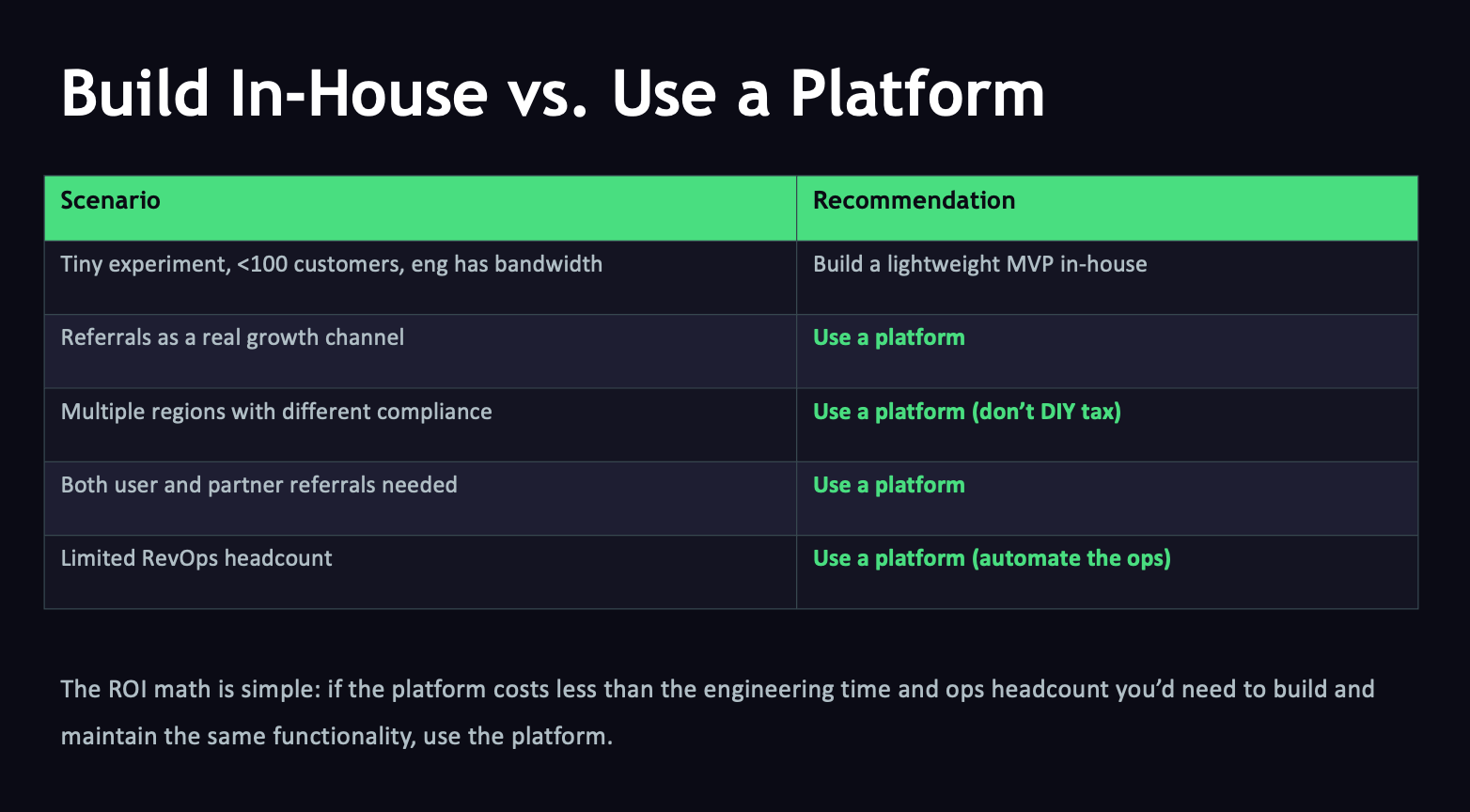
For most teams, that threshold is crossed quickly.
What to Look for in Referral Tech
Before you pick a tool, here’s what it needs to do:
CRM integration that actually works. Native sync with Salesforce, HubSpot, or your CRM of choice. Not CSV exports.
Flexible reward configuration. Support for cash, credits, tiered rewards, and recurring payouts.
Automated fulfillment. The platform should verify referrals, calculate rewards, and handle payments—including tax compliance across countries.
In-product embedding. Customers should be able to refer without leaving your app.
Partner portal. If you run affiliate programs, partners need a place to track their activity and payouts.
Real-time reporting. Performance data—participation rates, conversion rates, reward ROI—without building custom dashboards.
If you’re spending more time maintaining the infrastructure than optimizing the strategy, you’ve picked the wrong tool.
The Bottom Line
A referral program is only as good as its operational backbone. You can have the best incentive structure in the world, but if tracking breaks, rewards are late, or the experience is buried three clicks deep, participation will flatline.
RevOps’ job is to make referrals a system, not a campaign.
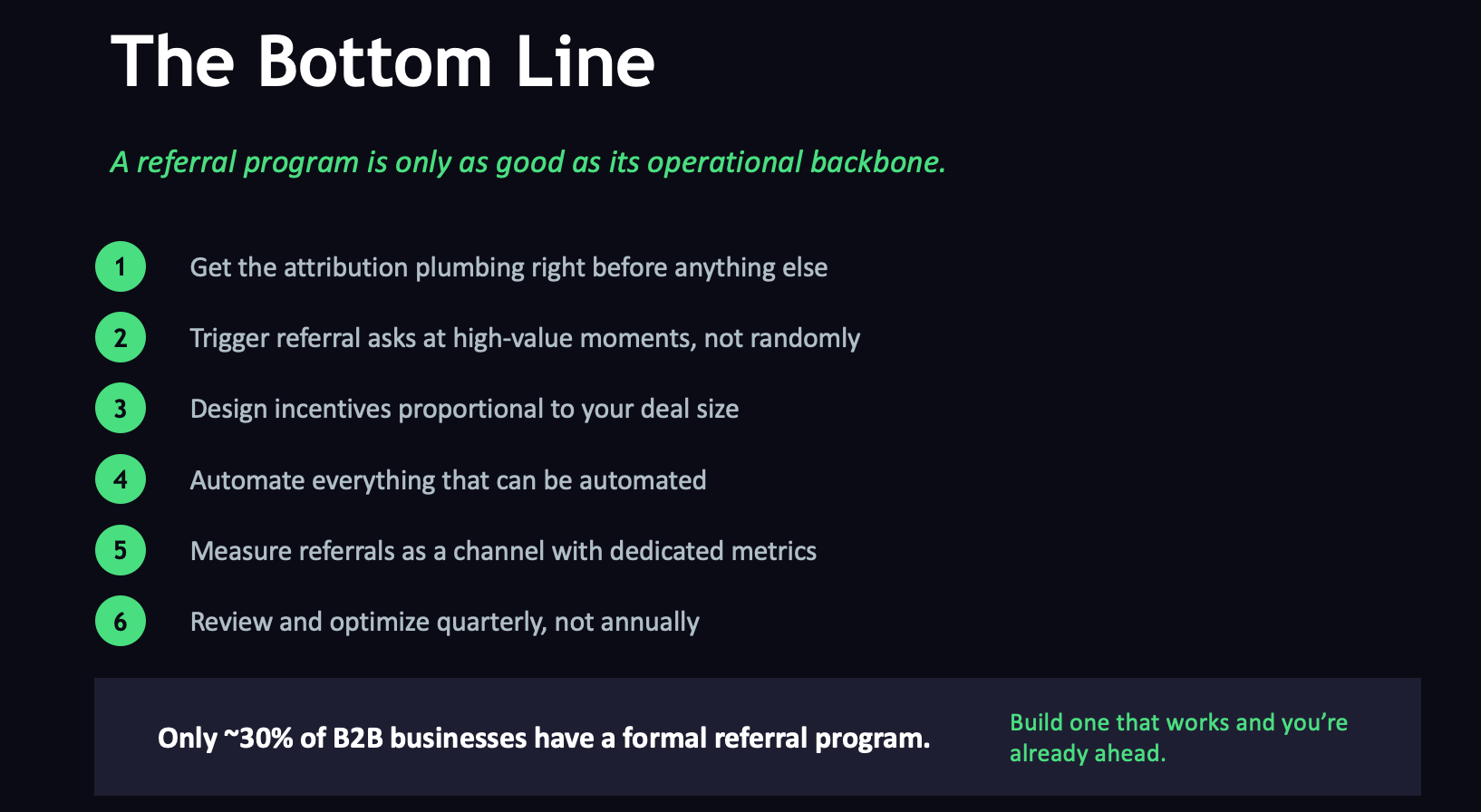
Get the attribution plumbing right before anything else. Trigger referral asks at high-value moments, not randomly. Design incentives proportional to your deal size. Automate everything that can be automated. Measure referrals as a channel with dedicated metrics. Review and optimize quarterly, not annually.
If you build one that actually works, you’re already ahead of 70% of your market.